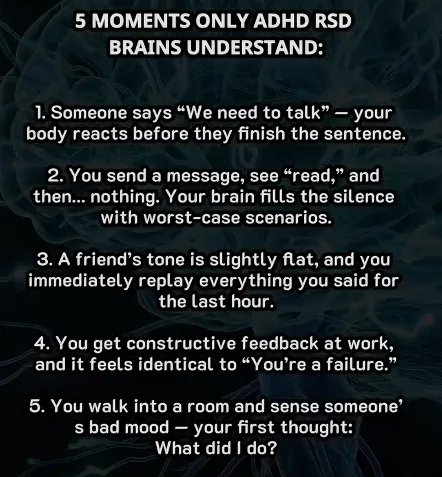
 5 Moments That Many People with ADHD and Rejection Sensitive Dysphoria (RSD) Understand
One of the least talked-about aspects of ADHD isn't the difficulty paying attention. It's the emotional intensity that often comes with it.
Many people with ADHD experience what is commonly called
Rejection Sensitive Dysphoria (RSD)—an unusually strong emotional reaction to criticism, rejection, disappointment, or even the
possibility of those things happening.
It's important to understand that RSD doesn't mean someone is weak, dramatic, or looking for attention. Their brain is often trying to predict and protect them from emotional pain before it even happens.
Here are five common examples.
1. Someone says, "We need to talk."
For many people, that's simply the beginning of a conversation.
For someone experiencing RSD, their brain may instantly assume something is wrong.
Before the other person even finishes the sentence, the mind may race through dozens of possibilities:
- Am I in trouble?
- Did I mess something up?
- Are they angry?
- Is this relationship over?
- Am I about to lose my job?
The body often reacts before logic has a chance to catch up. Heart rate increases, muscles tense, anxiety spikes, and the brain starts preparing for the worst.
Most of the time...
The conversation turns out to be something completely harmless.
2. You send someone a message...
They read it.
Then...
Nothing.
Most people simply assume the other person is busy.
Someone experiencing RSD may instead begin filling the silence with explanations that aren't actually based on evidence.
Maybe they're angry.
Maybe I said something wrong.
Maybe they don't like me anymore.
Maybe I embarrassed myself.
Maybe they're avoiding me.
The longer the silence lasts, the more convincing these imagined scenarios become—even though the person on the other end may simply be driving, working, asleep, or forgot to reply.
The brain dislikes uncertainty.
Unfortunately, RSD often fills uncertainty with fear.
3. Someone's tone changes slightly.
Imagine talking with a friend.
They become quieter than normal.
Or maybe they're tired.
Or distracted.
Or had a stressful day.
Most people notice the change and move on.
Someone with RSD may immediately begin replaying every conversation they've had over the past hour.
Did I offend them?
Did I say something stupid?
Were they upset when I joked about that?
Should I apologize?
The brain starts searching for a reason—even when there isn't one.
4. Constructive criticism feels like personal rejection.
Most people understand feedback as:
"Here's something you can improve."
Someone with RSD may emotionally hear:
"You failed."
"You're not good enough."
"I'm disappointed in you."
Even when they logically know the criticism is fair and intended to help, the emotional response can be overwhelming.
This often creates an interesting contradiction.
Many people with ADHD genuinely want feedback because they want to improve.
They simply wish it didn't hurt so much to receive it.
5. You walk into a room and someone seems upset.
You notice someone looks frustrated.
Before you know what happened...
Your brain asks:
"What did I do?"
It doesn't matter if their bad mood has absolutely nothing to do with you.
Your brain automatically checks whether you're responsible.
Maybe they're stressed about work.
Maybe they had an argument before arriving.
Maybe they're just tired.
But RSD often convinces people that if someone is unhappy nearby, they somehow caused it.
Understanding, Not Excusing
It's important to understand that RSD isn't an excuse for unhealthy behavior.
Instead, it's an explanation for why certain situations can feel so emotionally overwhelming.
Recognizing these patterns allows people to pause, question their assumptions, and remember something important:
Feelings are real. Conclusions aren't always accurate.Just because your brain predicts rejection doesn't mean rejection has actually happened.
Learning to separate emotion from evidence is one of the most valuable skills anyone with ADHD can develop.
Final Thought
ADHD isn't simply about attention.
It's about regulation.
Attention regulation.
Emotional regulation.
Impulse regulation.
Time regulation.
For many people, the hardest battles aren't visible from the outside.
Sometimes, the loudest struggle is happening entirely inside their own mind.
RSD doesn't necessarily make your emotions wrong—it can make your conclusions arrive before the evidence does. The feeling is real. The story your brain creates to explain it may not be.


Post Comments
No comments yet.