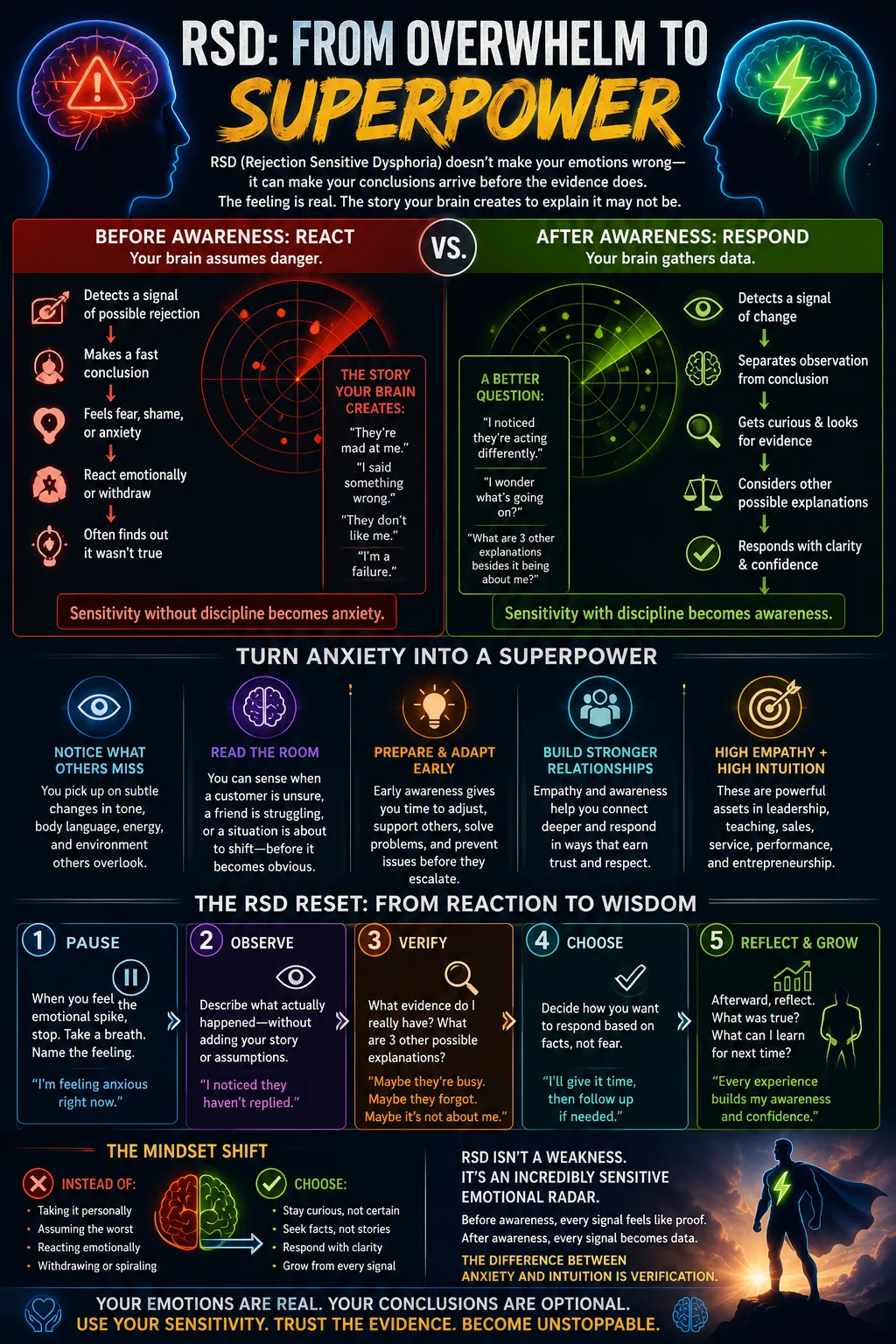
RSD as a Superpower
Rejection Sensitive Dysphoria can feel like a curse because your brain is trying to solve problems before it knows whether a problem exists.But once you recognize what's happening, the very sensitivity that once caused anxiety can become one of your greatest strengths.
Your brain notices tiny changes that many people never see.
A slight change in someone's facial expression.
A pause in their voice.
A shift in their energy.
A delayed response.
A subtle change in group dynamics.
Most people miss these signals completely.
Your brain doesn't.
The problem isn't that you notice them.
The problem is assuming you already know why they happened.
Separate Observation from Conclusion
This is the key.
Instead of thinking:"They're upset with me."
Train yourself to think:
"I noticed they're acting differently."
Those are two completely different statements.
The first is a conclusion.
The second is simply an observation.
Observations are incredibly valuable.
Conclusions require evidence.
Turn Anxiety into Curiosity
Once you stop assuming your first explanation is correct, something remarkable happens.The fear becomes curiosity.
Instead of asking:
"What did I do?"
You begin asking:
"I wonder what's going on."
That small change transforms your brain from a threat detector into a pattern detector.
And pattern detection is one of the greatest strengths many people with ADHD possess.Use It to Read the Room
Many entrepreneurs...
Teachers...
Managers...
Performers...
First responders...
Salespeople...
...are successful because they notice subtle changes other people overlook.
Someone with controlled RSD can often tell when:
A customer isn't convinced.
An employee is becoming overwhelmed.
A friend is struggling despite saying they're fine.
A meeting is about to go sideways.
An audience is disengaging.
Those observations allow you to respond before the situation gets worse.
That's emotional intelligence.
Verify Before You React
One simple habit changes everything.
Whenever your brain screams,
"They're mad at me!"
Ask yourself:
"What evidence do I actually have?"
Then ask another question:
"What are three other explanations that fit the same facts?"
Maybe they're tired.
Maybe they got bad news.
Maybe they're focused on something else.
Maybe they simply forgot to respond.
Your first explanation is rarely the only explanation.
The Gift Hidden Inside RSDMany people spend years trying to ignore their sensitivity.
But perhaps the goal isn't becoming less sensitive.
Perhaps it's becoming better at interpreting what your sensitivity detects.
Sensitivity without discipline becomes anxiety.
Sensitivity with discipline becomes awareness.
Awareness becomes insight.
Insight becomes wisdom.
My Favorite Way to Describe ItI don't think RSD gives people "false emotions."
I think it gives them real emotions generated from incomplete information.
Once you learn to pause between the emotion and the conclusion, something powerful happens.
Your emotions stop controlling your decisions.
Instead, your emotions become an early warning system that tells you,
"Pay attention. Gather more information before you decide what this means."
That's when RSD stops being a burden and starts becoming an advantage.
I'd end with this thought, because I think it captures the transformation:RSD isn't a weakness. It's an incredibly sensitive emotional radar.
Before awareness, every signal feels like proof.
After awareness, every signal becomes data.
The difference between anxiety and intuition is verification.🤩

Post Comments
No comments yet.